
Customers must sign the agreement promptly to avoid disruptions. They should read it thoroughly and understand their rights and obligations.

UPI has catapulted India into the forefront on the global digital payments landscape. Working hand in hand, the AePS payments system is making life easy for rural folks, notes Tamal Bandyopadhyay.

'Maharashtrians are facing a dual battle -- numerical battle with North Indians and financial battle with Gujaratis and Marwaris.' 'This has created anxiety about survival and ownership over Mumbai and Maharashtra.'

The move is to align affordable housing finance flows to the increase in property costs and inflation, says Raghu Mohan.

Google Pay, PhonePe, and Paytm may deliberately delay transactions, issue fraud alerts, and require an extra layer of user confirmation before processing any transactions that are likely to be classified as fraudulent.

'For 40 years, India valued only technical skills. IITs, coding -- that became everything.' 'Soft skills were sidelined. But those are the skills that will keep you employable now, not technical skills.'
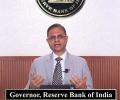
'India has the potential to grow at more than 7%, with the monetary policy providing a supportive hand.'

Among Sensex firms, Eternal, Infosys, Tata Consultancy Services, Tech Mahindra, Reliance Industries, Asian Paints, HCL Tech and Adani Ports were the laggards. Power Grid, Bajaj Finance, NTPC, State Bank of India and IndusInd Bank were among the gainers.

There is a need for real-time or near real-time credit reporting, instead of the current fortnightly system, to improve underwriting precision, enable timely reflection of borrower actions such as loan closures or repayments, and deliver a superior consumer experience, Deputy Governor of the Reserve Bank of India (RBI), M Rajeshwar Rao said on Wednesday.

The Reserve Bank on Friday announced a record Rs 2.69 lakh crore dividend to be paid to the government for the fiscal ended March this year, 27.4 per cent more than the payout in 2023-24. The Reserve Bank had transferred Rs 2.1 lakh crore dividend to the government for the fiscal 2023-24.

'AI analyses body language, etiquette, and communication skills, providing an in-depth performance matrix and a ranking system to help employees identify areas of improvement.'

Experts say the state's economy is grappling with hidden debt, rising welfare costs, and lack of transparency.

Retail inflation dipped to an over six-year low of 2.82 per cent in May due to subdued food prices, remaining below the RBI's median target of 4 per cent for the fourth consecutive month, according to government data released on Thursday. Consumer Price Index (CPI)-based retail inflation was 3.16 per cent in April and 4.8 per cent in May 2024.

With the interest rate cut cycle nearing its end, several debt fund managers are shifting their focus towards interest income rather than betting on duration in anticipation of capital gains.

Wholesale price inflation (WPI) declined to a 14-month low of 0.39 per cent in May on easing prices of food articles and fuel, and experts said geopolitical tensions could push up prices.

'We continue to view India as a standout within EM.'

PayPal Payments Pvt Ltd (PayPal), the Indian subsidiary of PayPal Holdings Inc, has received in-principle approval from the Reserve Bank of India (RBI) to operate as a Payment Aggregatorross Borderxports (PA-CB-E). This marks a key milestone in PayPal's operations in India and its continued support for Indian small businesses, enabling secure cross-border payments to approximately 200 markets, the company said in a statement.

India's forex reserves increased $1.98 billion to $688.13 billion during the week ended April 25, the RBI said on Friday. This is the eighth consecutive week of a rise in the kitty, which had jumped 8.31 billion to $686.14 in the previous reporting week.

The Reserve Bank of India (RBI) has extended the trading hours for the interbank call money market from July 1, and that of repo and tri-party repo markets from August 1. Market participants said the decision is intended to help reduce the large Standing Deposit Facility (SDF) balances held by banks with the RBI, thereby addressing liquidity mismatches.
'Deposit and lending rates have started to fall considerably. It is likely to spur investment and consumption of durables.'

In response to the panic triggered by Trump's trade policies, the RBI net sold approximately $43 billion in the second half of FY25 to curb volatility, as the rupee plunged to a low of 87.95 per dollar in February this year.

'You've got to understand it is not easy to die by suicide.' 'People commit suicide only when they lose everything and find no other way to live.'

The combined market valuation of the top-ten most valued firms jumped by a whopping Rs 3,84,004.73 crore in the holiday-shortened last week, in-tandem with a smart rally in equities, with HDFC Bank and Bharti Airtel emerging as the biggest gainers. Last week, the BSE benchmark Sensex jumped 3,395.94 points or 4.51 per cent, and the NSE Nifty surged 1,023.1 points or 4.48 per cent.

'Self-declaration from the customer in case of no change in KYC information or change only in the address details may be obtained.'
The Reserve Bank of India (RBI) brass, including its Governor Sanjay Malhotra, on Tuesday told a Parliamentary panel that it was "optimistic" about the impact of the US tariffs on the Indian economy and, in long-run, it could benefit the country due to dipping trade relations between the US and China.

The high value Rs 2000 notes worth Rs 6,266 crore are still in circulation after two years of the Reserve Bank withdrawing the currency, according to official data. The Rs 2000 banknotes continue to be legal tender.

Foreign brokerages remain cautious on the road ahead for the Indian equity markets. Though analysts at Nomura have revised their March 2026 Nifty target to 26,140 levels from the earlier 24,970, but the upside from the current levels is a modest 6 per cent. BofA Securities, on the other hand, has not made any change to its year-end Nifty target.

They don't just want better returns -- they're looking for global opportunities, more variety and smarter ways to grow their money, says Soubho Moulik, CEO, Appreciate.

'The universe of PSU stocks is huge and diverse.' 'Investors should bet on specific sectors and stocks from the basket as most of them may continue to consolidate after years of outperformance.'

The revised ceiling will be within the Rs 10 lakh mark.

State Bank of India (SBI) on Saturday reported 10 per cent fall in standalone net profit at Rs 18,643 crore for the fourth quarter ended March 2025. The country's biggest lender had earned a profit of Rs 20,698 crore in the January-March period of 2023-24.

Filling of Rs 100 and Rs 200 notes result in faster depletion and more frequent cash replenishment. This will cost banks and managed service providers more.
Like with all great crashes, some had noticed the cracks. "... cash balances (of banks) seem, from the available indications, to be hopelessly inadequate; and it is hard to doubt that in the next bad times they will go down like ninepins. If such a catastrophe occurs, the damage inflicted on India will be far greater than the direct loss falling on the depositors," said John Maynard Keynes in his May 1913 work "Indian Currency and Finance", written before his path-breaking work in macroeconomics laid the foundation of dealing with global crises.

Foreign investment in bonds issued by Indian corporates touched a 10-year high in May at 20,996 crore, driven by $3.35 billion fundraise by the Shapoorji Pallonji (SP) group, which saw infusion from Deutsche Bank, BlackRock, Morgan Stanley, Davidson Kempner, and Cerberus Capital, among others. The SP group sold three-year bonds, offering 19.75 per cent yield compounded annually and payable at maturity.
